The Worst Ways to Redeem KrisFlyer Miles—and the Mistakes to Avoid

KrisFlyer miles can unlock memorable flights. They can also disappear into an overpriced redemption, an unsuitable ticket or—most painfully—an expiry notice.
For beginners, the biggest risk is not failing to find the mathematically perfect award. It is treating miles like cash, forgetting that they are perishable, or moving them before there is a realistic plan. If you are still learning the programme, begin with the GenieMiles KrisFlyer beginner’s guide.
Do not hoard miles indefinitely, but do not panic-spend them either. Build towards a real trip, compare the full cost and redeem while the miles can still improve your travel.
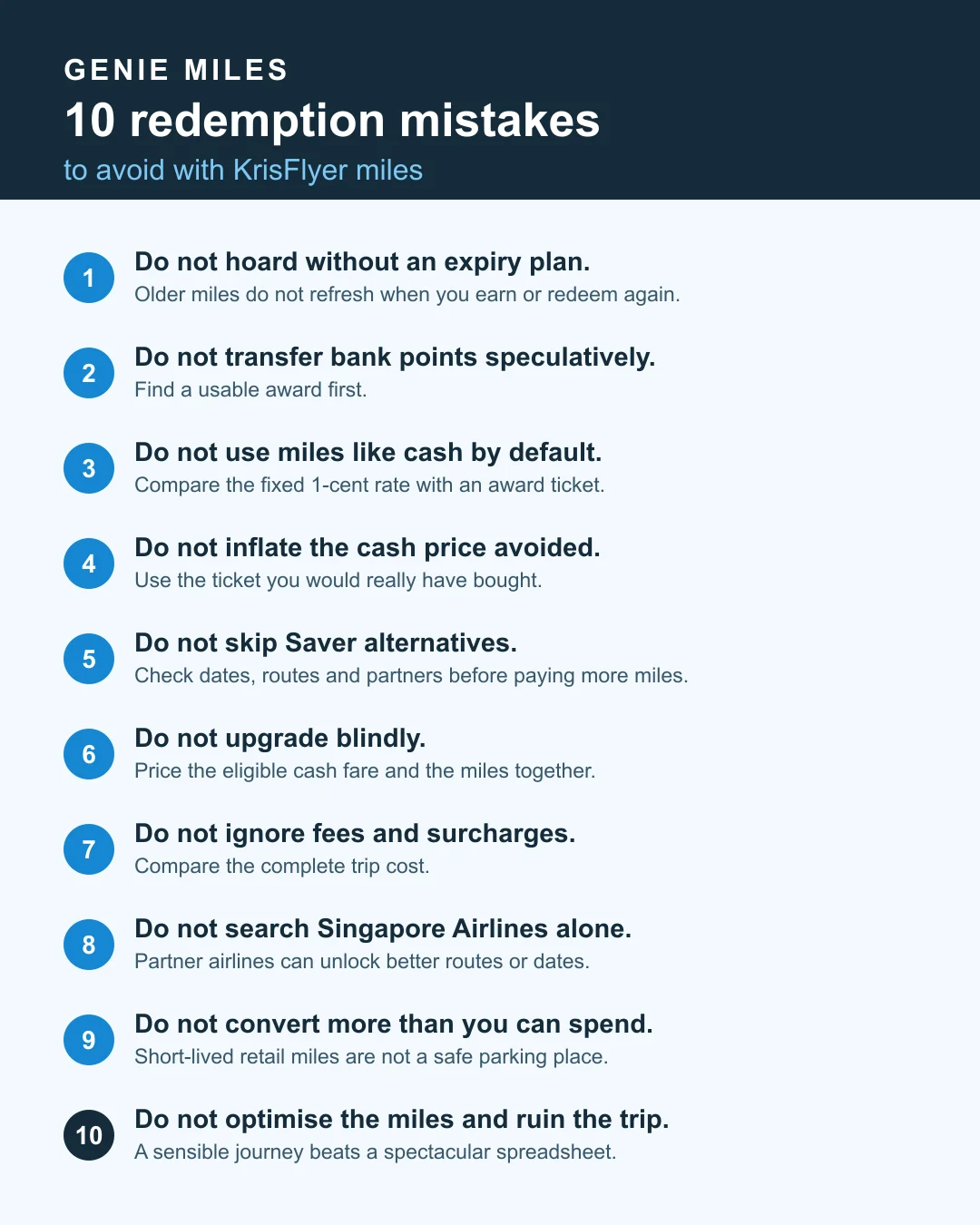
Quick take: 10 KrisFlyer redemption mistakes to avoid
- Do not hoard without an expiry plan. New activity does not refresh older miles.
- Do not transfer bank points speculatively. Find a usable award first.
- Do not use miles like cash by default. Compare the fixed-value offset with an award.
- Do not confuse an expensive ticket with real savings. Use the cash option you would really buy.
- Do not choose Advantage or Access before checking Saver alternatives.
- Do not upgrade blindly. Price the eligible fare and upgrade miles together.
- Do not ignore taxes, surcharges or cancellation fees.
- Do not search Singapore Airlines alone. Partner awards create more options.
- Do not convert more than you can spend.
- Do not optimise the miles and ruin the trip.
1. Do not hoard KrisFlyer miles without an expiry plan
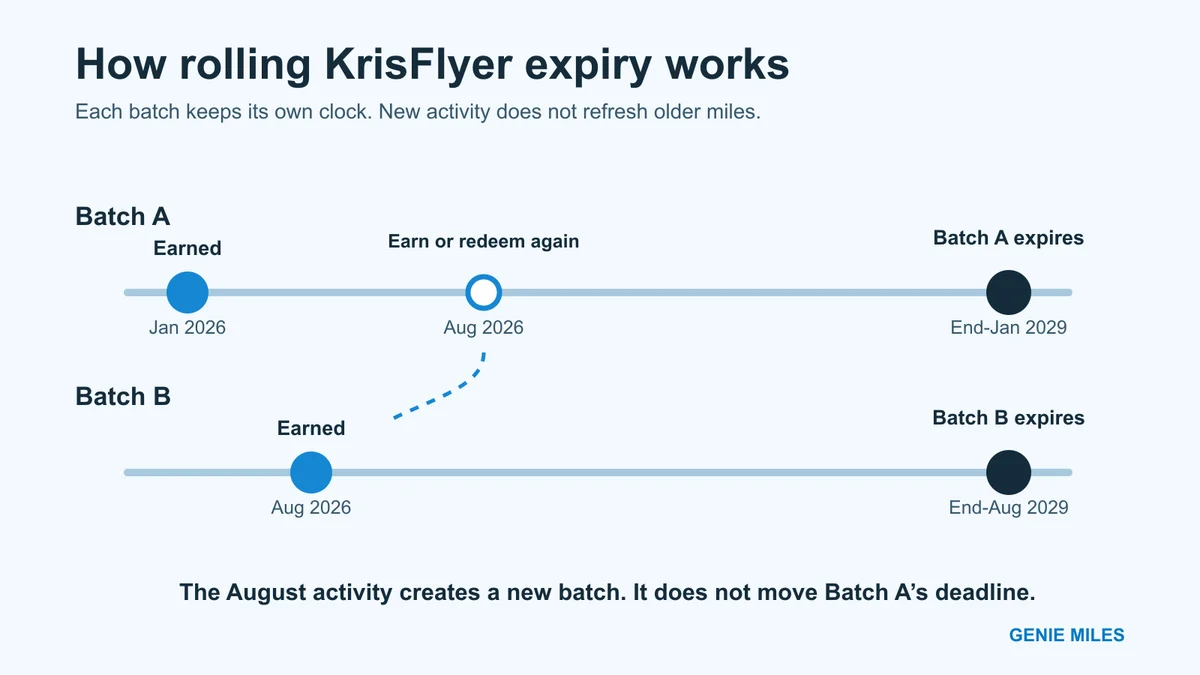
Hoarding is especially dangerous with KrisFlyer because most members face a strict, rolling 36-month expiry policy.
For KrisFlyer Basic, Elite Silver and Elite Gold members, each batch of miles generally expires at the end of the corresponding month three years after it was earned. Miles credited in January 2026 would normally expire at the end of January 2029. Miles credited in August 2026 have their own later deadline.
This is not an activity-based system. Flying again, spending on a card, transferring fresh points or making a redemption does not reset the clock on older KrisFlyer miles.
PPS Club members are the major exception: valid miles generally do not expire while PPS Club membership is retained, although promotional miles can have separate conditions.
Check Miles → Miles validity in your KrisFlyer account, set reminders six and twelve months before expiry, and keep flexible bank points outside KrisFlyer until they are needed.
KrisFlyer currently offers eligible members a one-time extension for a fee. The published charge is 1,200 miles or US$12 per 10,000 miles—or part thereof. Basic members receive six additional months; eligible Elite members receive 12 months. Use an extension to execute a real plan, not to postpone the problem.
You normally need to redeem before expiry rather than complete the flight before that date. But if you later cancel after the underlying miles have expired, those miles may not return.
2. Do not transfer bank points before finding a usable award
Bank rewards points are valuable partly because they are flexible. Once they enter KrisFlyer, the transfer is generally one-way: the points cannot simply return to the bank when your preferred seat disappears.
- Choose a journey and backup dates.
- Search for the required number of award seats.
- Check your bank’s transfer time, conversion block and fee.
- Transfer only what you need.
- Book as soon as the miles arrive.
Award space can disappear while a transfer is processing, so backups matter. A transfer bonus does not justify moving points without a use: more of a currency you cannot spend is not a saving.
3. Do not automatically use miles to offset a cash price
Singapore Airlines, Scoot, KrisShop and Kris+ make it easy to spend miles at a fixed rate. The published rate is 100 KrisFlyer or KrisPay miles for S$1, equivalent to 1 cent per mile.
Suppose 100,000 miles remove S$1,000 from a cash purchase. The value is exactly 1 cent per mile. Now imagine a flight award replacing a realistic S$2,350 ticket and requiring the same 100,000 miles plus S$150 in award taxes. The net saving is S$2,200, or 2.2 cents per mile.
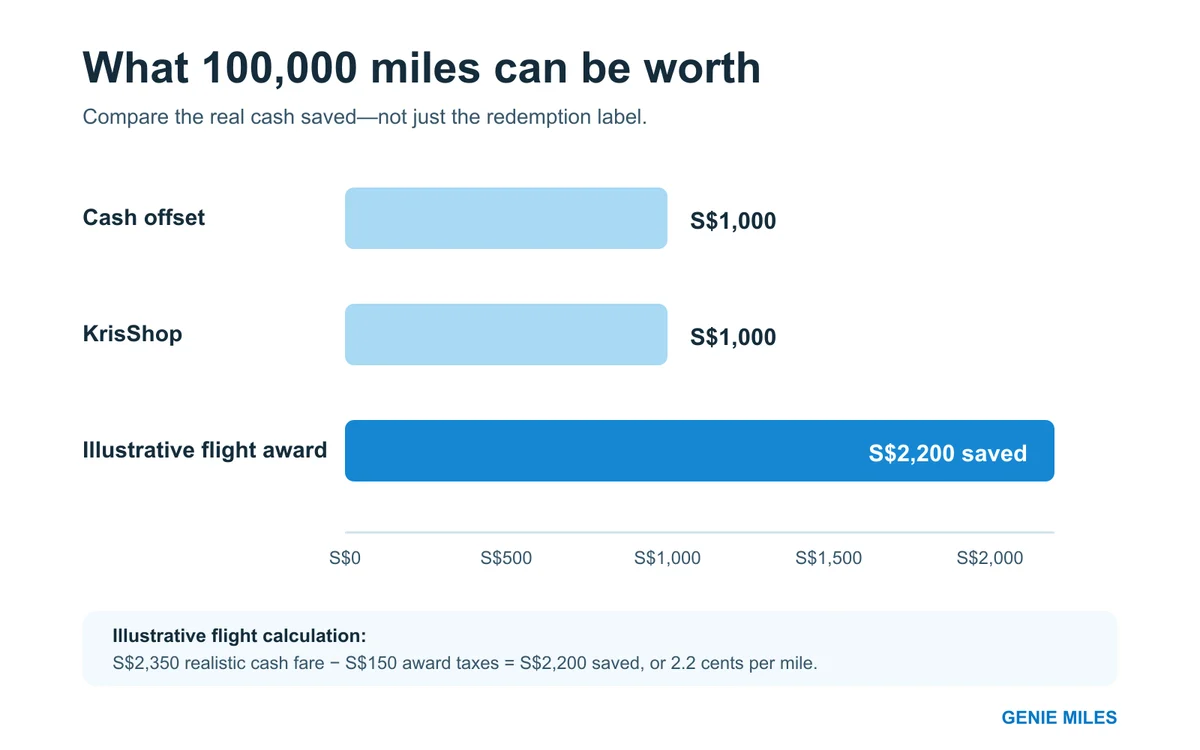
A fixed 1-cent redemption can still be sensible when miles are close to expiry, the balance is too small for an award, suitable seats are unavailable or protecting cash matters more than maximising value. The mistake is using it by default without comparing.
For another fixed-value example, see why the improved KrisFlyer-to-yuu conversion can still be a poor redemption.
4. Do not redeem for merchandise before checking the retail price
KrisShop currently offers the same headline conversion of 100 miles for S$1. Check the item against reputable Singapore retailers, including sale prices, warranty, delivery and the card rewards you would earn by paying cash. If a S$500 item is available elsewhere for S$420, using 50,000 miles at KrisShop has not created S$500 of practical value.
Merchandise is best treated as an expiry escape route or a deliberate lifestyle choice—not the natural home of a large balance.
5. Do not convert a large balance to KrisPay without an immediate use
Kris+ turns miles into everyday-spending currency at participating merchants. KrisPay miles transferred from KrisFlyer are generally valid for six months from the month of conversion and cannot be moved back into KrisFlyer.
Convert only what you expect to spend soon. Do not confuse converted miles with KrisPay miles earned from an eligible merchant transaction: eligible earned miles can generally be transferred to your linked KrisFlyer account at a 1:1 ratio within 21 days.
6. Do not pay for a more expensive award tier before checking alternatives
Singapore Airlines awards may appear at different levels, including Promo, Saver, Advantage and Access. Saver usually requires fewer miles but has less availability. Advantage and Access can solve a real availability problem, yet the mileage premium may be substantial.
Check nearby dates, one-way combinations, another flight on the same day, partner airlines, nearby airports and the actual cash fare. Paying more can be rational when it secures the only workable trip; it is wasteful when a modest date change achieves the same result.
7. Do not redeem an upgrade without pricing the whole journey
Only selected paid fare classes are eligible for upgrades, and the cheapest Economy or Premium Economy ticket may not qualify. Compare the cheapest acceptable fare, the eligible fare plus upgrade miles, and a premium-cabin award plus taxes.
Upgrades may also be charged by flight sector. Confirm the operating airline, eligible booking class and actual upgrade availability before transferring points.
8. Do not ignore taxes, partner surcharges and service fees
An award ticket is not necessarily free. Compare miles, government taxes, carrier surcharges, positioning flights, hotel nights, airport transfers and the flexibility you surrender.
KrisFlyer publishes fees for changes, cancellations and offline assistance. A no-show charge can be added to another applicable fee. If plans change, deal with the booking before departure.
9. Do not search only Singapore Airlines flights
KrisFlyer miles can be redeemed on Star Alliance airlines and selected other partners. That can unlock a nonstop route Singapore Airlines does not operate, a domestic connection overseas or a seat when Saver availability is absent.
Partner awards can have different mileage, routing restrictions and surcharges, but ignoring them removes useful options. Check the words “operated by” on every segment: an SQ flight number does not necessarily mean Singapore Airlines operates the flight.
For Singapore Airlines-operated flights, use the GenieMiles KrisFlyer redemption calculator to compare Saver and Advantage mileage for your route and travel party.
10. Do not maximise cents per mile at the expense of the trip
Premium-cabin awards often produce a higher cents-per-mile figure because their cash fares are high. That does not make Economy awards automatically bad. A family needing four school-holiday seats may receive more real value from Economy than from placing one person in Business Class.
Be cautious with separate tickets, unprotected connections, long detours, airport changes, extra hotel nights and dates that do not suit the travellers. The best redemption is not the most impressive spreadsheet. It is the one that takes you where you want to go, at a cost you accept, with risks you understand.
The GenieMiles pre-redemption check
- Would I take this trip if miles were not involved?
- What cash ticket would I realistically buy?
- What is the value per mile after taxes and fees?
- Have I checked Saver, partner flights and nearby dates?
- Is an upgrade genuinely cheaper than a full award?
- When does this mileage batch expire?
- What happens if I change or cancel?
- Am I transferring or converting more than I need?
GenieMiles verdict
Bad KrisFlyer redemptions usually begin with one of two impulses: “I must keep these miles forever” or “I must spend them now.” Resist both.
Keep bank points flexible until there is a likely booking. Track KrisFlyer expiry by earning batch. Compare fixed-value spending with an award, and judge the award against the trip you would really buy.
Miles are meant to be used. The trick is to spend them deliberately—not desperately.
Questions or a useful tip?
Which KrisFlyer redemption mistake have you made—or narrowly avoided?
Be the first reader to add something useful.